AIED 2026 Poster: Designing AI Teammates for VR Algebra Support
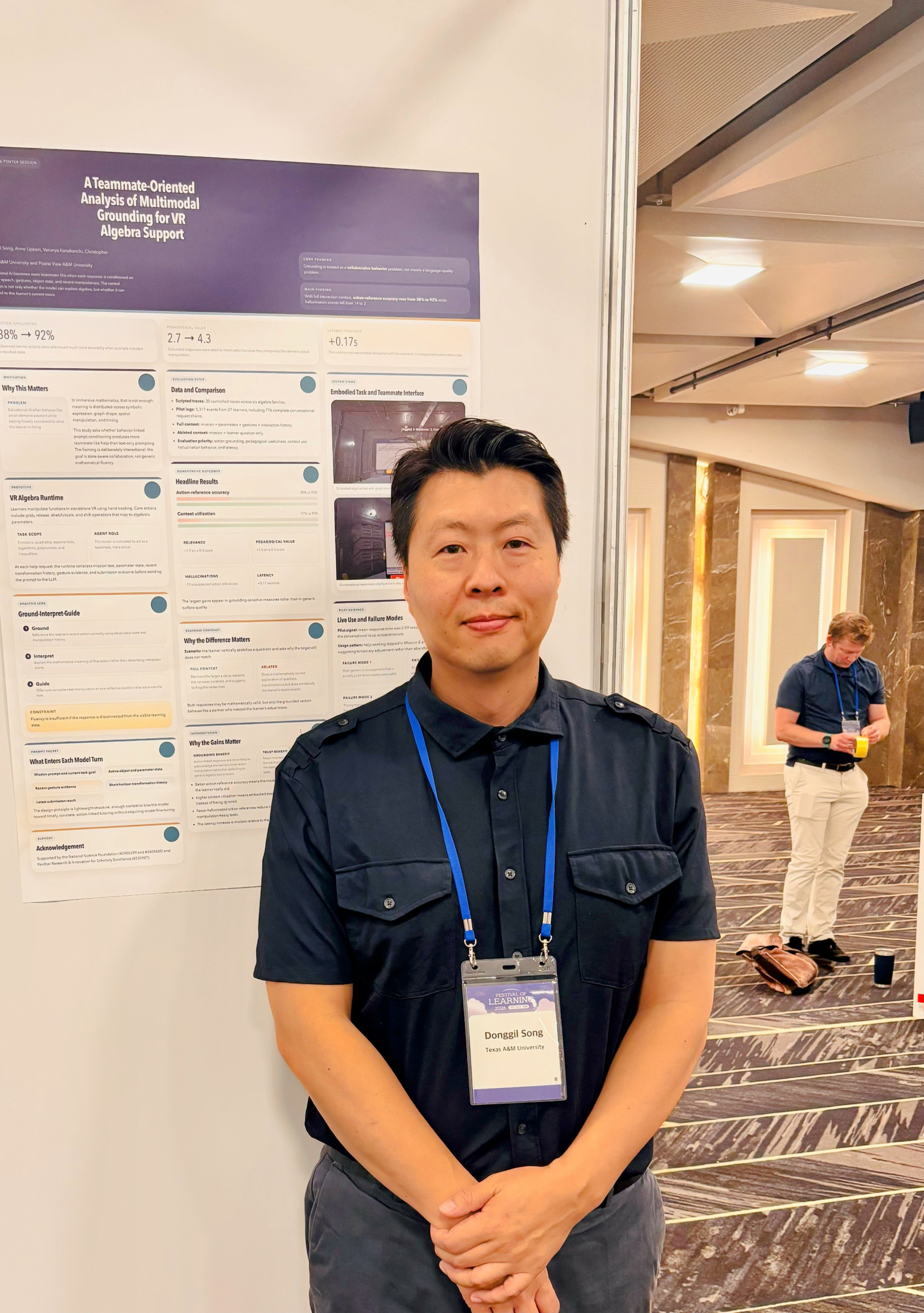
Einbrain Lab is pleased to share that Donggil Song presented our research poster at AIED 2026, together with a group of colleagues and our undergraduate research assistants Varunya Konakanchi and Christopher Beltran.
The poster, “A Teammate-Oriented Analysis of Multimodal Grounding for VR Algebra Support,” explores how AI systems can better support students during immersive mathematics learning. The central idea is simple but important: if an AI teammate is going to help a student in a virtual reality algebra environment, it should understand more than the student's spoken question. It should also stay connected to what the learner just did, what changed in the task, and what action might make sense next.
Why This Work Matters
In VR algebra, students do not only type answers. They move, stretch, shift, and manipulate mathematical objects. Those actions carry meaning. A learner may be changing the shape of a graph, testing a parameter, or trying to understand why a target has not matched yet. A generic tutoring response can miss that context, even when the language sounds fluent.
Our work asks how an educational AI teammate can ground its response in the learner's immediate activity. The system connects conversational support with multimodal context from the VR environment, including task state, recent manipulations, gesture evidence, and interaction history. The goal is not to make the AI solve the problem for the student, but to help it notice what the student is doing, interpret that action mathematically, and suggest a useful next step.
Ground, Interpret, Guide
The study frames teammate-like support through a three-part move: ground the response in the learner's recent action, interpret what that action means mathematically, and guide the learner toward one next manipulation or reflective question. This framing helps evaluate whether the AI is acting like a useful collaborator rather than a detached answer generator.
In scripted traces from the prototype, adding full interaction context substantially improved action-reference accuracy, relevance, and pedagogical value, while reducing unsupported action references. These results are early interaction-quality findings, not final claims about learning gains, but they suggest that multimodal grounding is a practical design priority for AI teammates in embodied learning environments.
Proceedings Publication
This work was also published in the AIED 2026 proceedings:
Song, D., Lippert, A., Konakanchi, V., & Beltran, C. (2026). A teammate-oriented analysis of multimodal grounding for VR algebra support. In E. G. Blanchard, G. Chen, M. Chi, & S. Isotani (Eds.), Artificial Intelligence in Education, Communications in Computer and Information Science, Vol. 3031. Springer. Read the proceedings article.
We are grateful for the National Science Foundation support behind this project and for the opportunity to share this work with the AIED community. We are especially proud of the contributions from our undergraduate research assistants, whose work helped move this project from prototype development toward research dissemination.
This project continues Einbrain Lab's broader effort to design AI and XR learning systems that are grounded, useful, and human-centered in real learning activity.