New NSF Grant: AI-Driven Professional Learning for Pre-Service Math Teachers (Award #2538780)
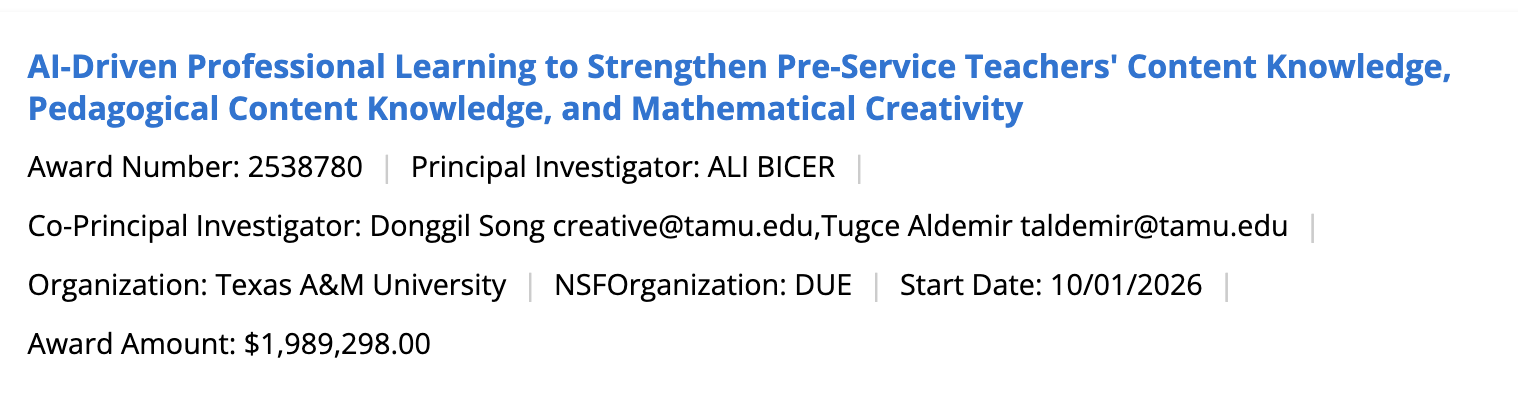
Einbrain Lab is joining a newly funded National Science Foundation project as a Co-PI team. The project, “AI-Driven Professional Learning to Strengthen Pre-Service Teachers’ Content Knowledge, Pedagogical Content Knowledge, and Mathematical Creativity” (Award #2538780), carries a total award of $1,989,298 and runs from October 2026 through September 2031. It is funded through the NSF IUSE: EDU Program and the Robert Noyce Teacher Scholarship Program, under the Directorate for STEM Education.
The project is led by PI Dr. Ali Bicer (Texas A&M University), with Co-PIs Dr. Donggil Song (Einbrain Lab, Texas A&M University) and Dr. Tugce Aldemir (Texas A&M University).
The Problem
The United States faces a persistent shortage of well-prepared mathematics teachers, especially in rural and high-need communities. Many pre-service teachers enter preparation programs with limited confidence in mathematics and insufficient preparation to foster creative, conceptually rich instruction. This is not simply a pipeline problem; it is a preparation problem. Teachers who lack deep content understanding and flexible pedagogical strategies pass those limitations on to students.
Mathematical creativity (the ability to see problems from multiple angles, pose original questions, and build flexible understanding) is rarely a focus of traditional teacher preparation. Yet it is exactly this kind of thinking that prepares students to reason, not just compute.
What This Project Does
This Level 3 Engaged Student Learning project develops and studies an AI-guided professional learning model designed to strengthen three interconnected capacities in pre-service mathematics teachers:
- Content Knowledge (CK): deep understanding of the mathematics itself
- Pedagogical Content Knowledge (PCK): knowing how to teach that mathematics effectively
- Mathematical Creativity: the capacity for flexible problem solving and original mathematical thinking
Pre-service teachers engage with interactive AI-guided modules covering fraction computation and rate and proportional reasoning, two domains known to be challenging for both learners and teachers. Through the modules, participants practice flexible problem solving, problem posing, instructional analysis, and structured reflection on creativity-directed teaching practices.
The AI system functions as a cognitive partner: it delivers adaptive prompts, scaffolded feedback, and metacognitive questioning tailored to each participant’s responses in real time. Rather than presenting a fixed curriculum, the system responds to how each teacher-learner thinks, pushing toward deeper engagement rather than surface completion.
The model will be embedded within teacher preparation programs at eight geographically diverse institutions, including both rural-serving and urban-serving universities, and is designed to be accessible, adaptive, and scalable across diverse institutional contexts.
Einbrain Lab’s Role
The research vision and domain expertise for this project come from the PI team. Einbrain Lab’s contribution is the technology engineering and development layer: designing, building, and deploying the AI-driven learning support systems that make the professional learning intervention functional and scalable.
This is the kind of work our lab does across projects. We build the technology infrastructure that turns educational research designs into working systems that can operate at scale, adapt to individual learners, and generate the interaction data needed to answer research questions rigorously. On this project, that means developing the AI modules, the adaptive feedback engine, and the interaction architecture that powers the professional learning experience.
We bring experience building human learning support technology across AI and XR contexts, and this project extends that work into the specific domain of pre-service teacher preparation at scale.
Why This Research Matters
Improving how teachers are prepared is one of the highest-leverage investments in education. A single well-prepared teacher shapes the mathematical experience of hundreds of students across a career. A model that works at scale and generates evidence to justify federal investment that can shift how the field approaches teacher preparation more broadly.
This project contributes to the emerging field of AI-supported teacher education in three ways:
- Advancing theoretical integration of content knowledge, pedagogical content knowledge, and mathematical creativity as interconnected rather than independent constructs
- Providing multi-site empirical evidence of AI-supported professional learning in pre-service contexts
- Developing a scalable, transferable model for mathematics teacher preparation that can extend to additional mathematical domains and diverse teacher education settings
The study uses a mixed-methods research design, including hierarchical linear modeling and qualitative analyses of classroom observations, interviews, and AI interaction logs, to examine how changes in knowledge and creativity interact to support teaching practice during practicum.
A Note to Education and Training Researchers
If you are an education or training researcher working on learning interventions that need a technology engineering and development partner, Einbrain Lab builds exactly that. We specialize in human learning support systems across AI and XR, from design through deployment. We are interested in collaborations where the research question is well-defined and the technology needs to be built rigorously. Get in touch.