We are excited to share a recently published paper from our research lab that explores innovative approaches to supporting technical writing skills in engineering education, particularly in the context of generative AI tools.
This work was conducted as part of the KVIS Project, supported by Panther Research & Innovation for Scholarly Excellence (Award #02-230444)
The Paper
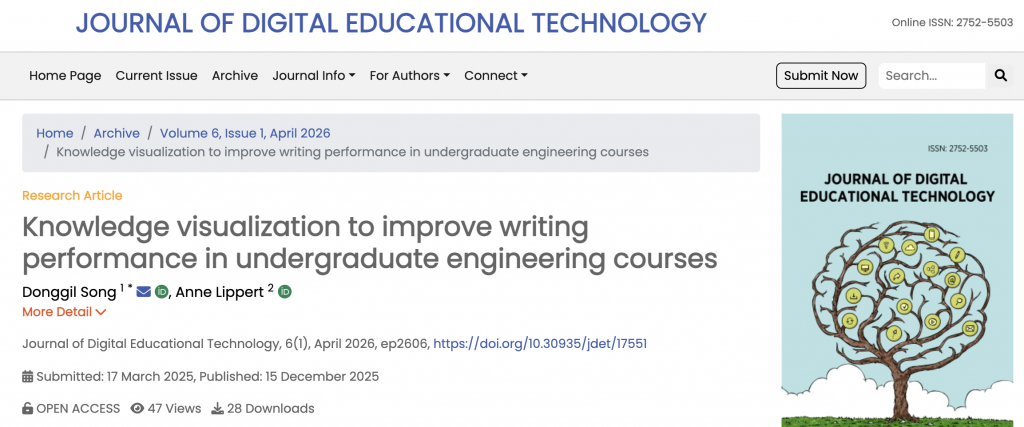
Title: Knowledge Visualization to Improve Writing Performance in Undergraduate Engineering Courses Authors: Donggil Song (Texas A&M University, College Station, TX, USA) and Anne Lippert (Prairie View A&M University, Prairie View, TX, USA) Published in: Journal of Digital Educational Technology, 2026, Volume 6, Issue 1, ep2606 Access the full paper: Download PDF
Overview and Motivation
The rise of generative artificial intelligence (AI) has raised concerns about its potential negative impact on students’ authentic writing skills in engineering education. This exploratory study investigates an alternative approach: using knowledge visualization integrated with self-regulated learning (SRL) principles to support students’ monitoring and evaluation processes during writing tasks.
We developed and tested a Knowledge Visualization System (KVIS) that employs machine learning-based text analytics to provide real-time visual feedback on students’ knowledge structures as they write. This tool helps students identify knowledge gaps and refine their organization without generating text for them, promoting genuine skill development.
Study Design and Participants
The study involved 30 undergraduate students from two sections of an engineering technology course. Participants completed six essay-writing tasks over the semester using KVIS. SRL skills were assessed via a survey, and final course grades were used as a measure of overall learning performance (LP). Writing performance (WP) was evaluated across multiple assignments.
Key Findings
- Students’ writing performance improved significantly over time as they repeatedly used the system.
- No significant relationships were found between students’ SRL traits, overall learning performance (course grades), and improvements in writing performance. Regression analysis confirmed that SRL and course grades do not predict writing gains.
- The visualization support appeared to benefit students broadly, with no differences in improvement trajectories between high- and low-SRL or high- and low-LP groups.
- A notable interaction effect was observed: lower-performing students showed particular gains in the “evaluating” component of writing, suggesting the tool effectively scaffolds self-assessment for those who need it most.
These results highlight the potential of knowledge visualization as a non-generative AI scaffold to foster authentic writing skills in STEM contexts.
Implications for Engineering Education
Effective communication is a core competency for engineers. As generative AI becomes ubiquitous, tools like KVIS offer a promising way to support self-regulated learning and knowledge organization without undermining skill development. This work builds on prior information-processing frameworks and opens avenues for future domain-specific applications in engineering curricula.
We are grateful for the collaboration between Texas A&M University and Prairie View A&M University that made this research possible, and we look forward to expanding on these findings in larger-scale studies.
If you’re interested in knowledge visualization, educational technology in STEM, or related topics, we welcome your feedback and questions. Feel free to reach out!
Reference: Song, D., & Lippert, A. (2026). Knowledge visualization to improve writing performance in undergraduate engineering courses. Journal of Digital Educational Technology, 6(1), ep2606. https://doi.org/10.30935/jdet/17551