The Einbrain Lab recently showcased its latest innovation in immersive learning: Prehistoric Protocols. Presented at the ASEE GSW 2026 conference by Jack MacMiller (IT Engineer Intern at Einbrain Lab) this project reimagines undergraduate Computer Networks education through a unique blend of virtual reality and generative AI.
The Challenge: Abstract Concepts in a Physical World
Undergraduate courses in Computer Networks and Information Technology (IT) are widely regarded as challenging due to the abstract nature of protocols and addressing schemes. While traditional network simulators help, they can under-serve students who learn best through embodied and narrative-driven experiences.
The Solution: A Stone Age Adventure
Prehistoric Protocols is a work-in-progress VR learning environment that transports students to a prehistoric world where cavemen have “mysteriously” discovered modern networking equipment. Students step into the role of time-traveling experts, guiding these prehistoric characters through technical challenges using gesture-based manipulations and natural voice commands.
Event Highlights
-
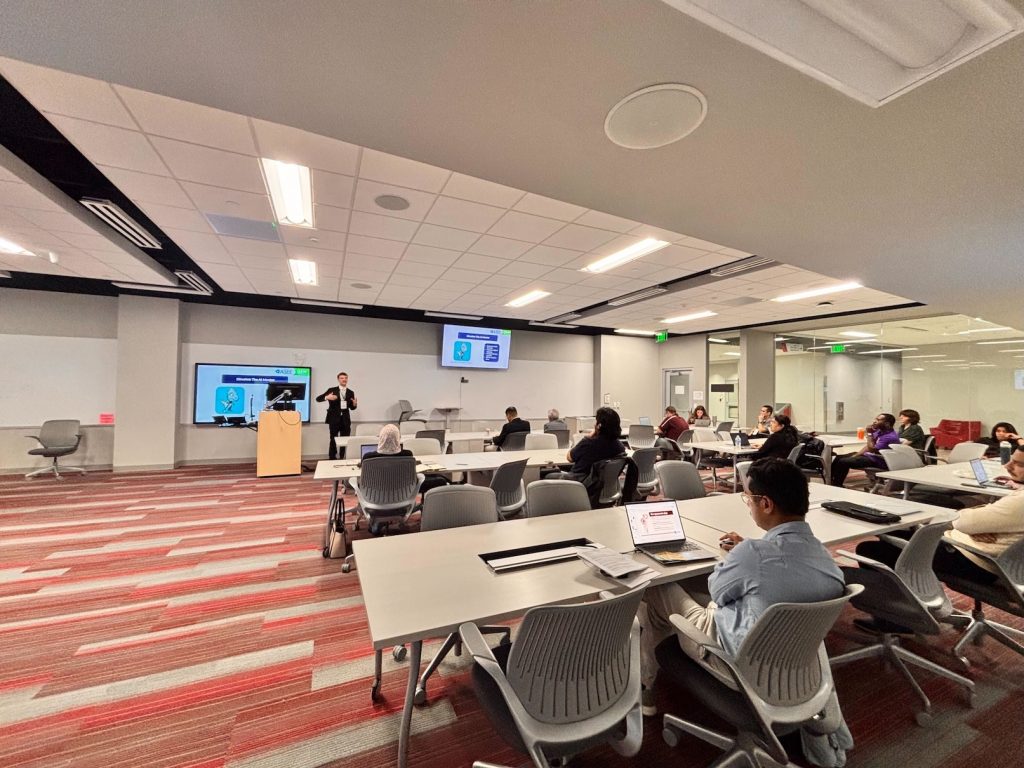
The Presentation Environment: Jack MacMiller presenting “Prehistoric Protocols” to an engaged audience at the ASEE GSW conference. The room setup highlights the integration of immersive tech talk within a traditional academic setting.
-
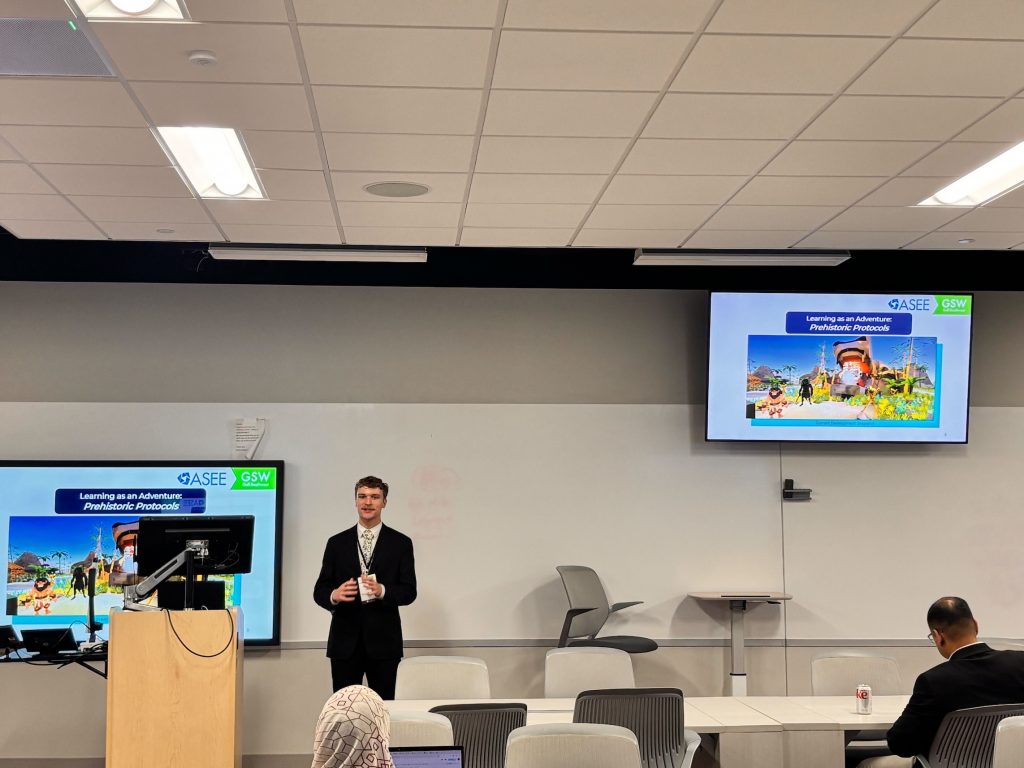
Core Concepts: Jack explains the narrative-driven design, where CCNA-aligned objectives are mapped to prehistoric metaphors to promote memorability and conceptual fidelity.
-
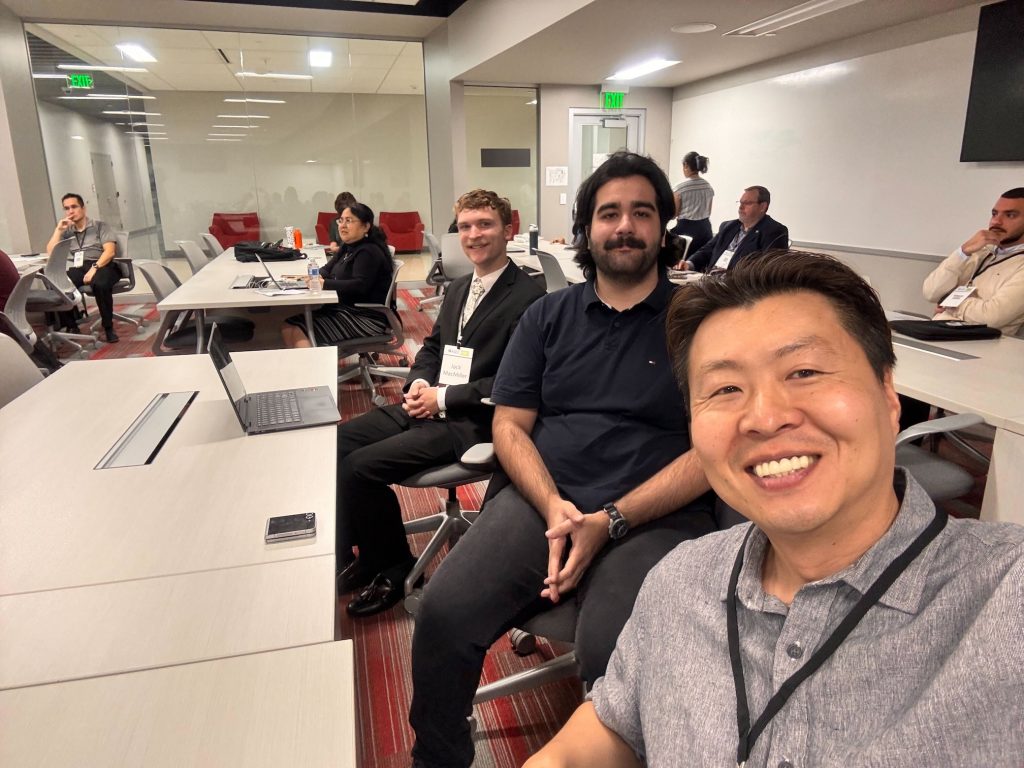
The Einbrain Lab Team: A selfie featuring (from front to back) Dr. Donggil Song (Director of Einbrain Lab), Ozan Akbulut (XR Engineer Intern), and Jack MacMiller (IT Engineer Intern) during the conference sessions.
-
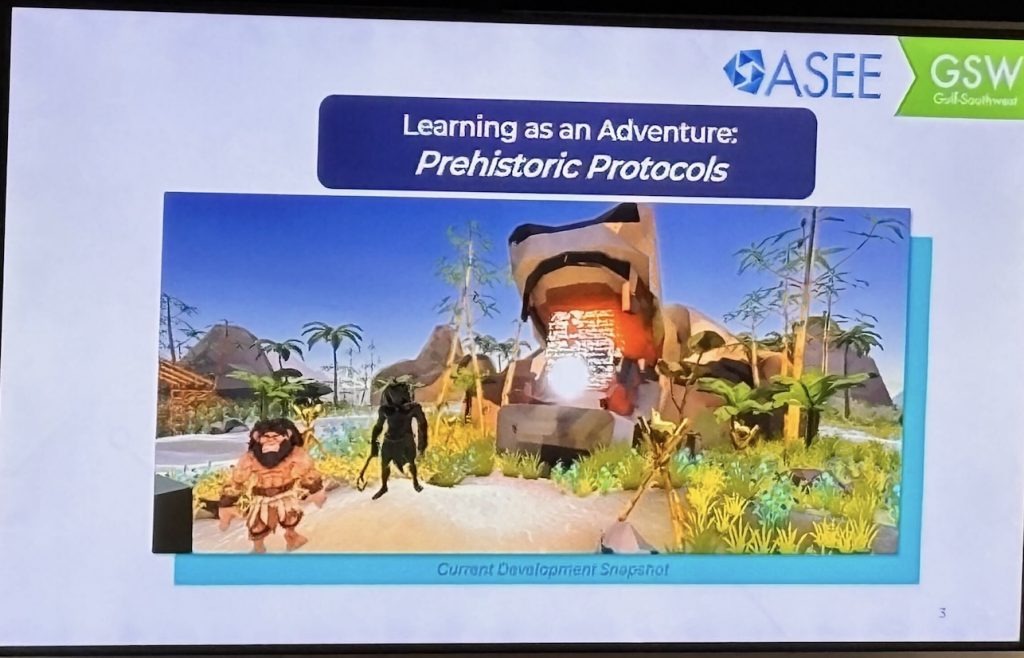
Development Snapshot: A close-up of the Unity-based VR environment. This slide shows the “Fire Drum” and “Clan” assets used to teach OSI layers and subnetting through immersive metaphors.
Curriculum Mapping
The system bridges the gap between play and professional certification by mapping CCNA (Cisco Certified Network Associate) objectives to in-world activities:
-
OSI/TCP-IP Layers: Visualized as a message chain moving from a drum to a runner to a chief.
-
IP Addressing & Subnetting: Taught by dividing berry fields among different clans using “mask stones” to set boundaries.
-
Routing (RIP, OSPF): Represented by dinosaur migration trails, where students draw paths and observe network convergence.
-
Troubleshooting: Challenges like “blocked rivers” or “spirit confusion” require students to use CLI-style voice commands to diagnose and fix connectivity failures.
AI Mentorship: Meet DinoNet
To ensure students never feel lost, the system features DinoNet, a generative AI mentor represented as a dinosaur character. Developed by main developer Ozan Akbulut (XR Engineer Intern at Einbrain Lab), the AI pipeline uses the OpenAI GPT API to deliver context-aware, metaphor-aligned explanations.
The Path Forward
Currently, the system’s core VR world and assets are approximately 90% complete, with three core learning scenarios already playable. The team is preparing for a controlled pilot study with 60 IT undergraduate students to evaluate how this combination of VR and AI impacts learning gains, usability, and cognitive workload compared to traditional lab settings.
By turning abstract protocols into tangible, narrative-driven experiences, Einbrain Lab is paving the way for a more engaging and scalable future in technical education.
This project is funded by the National Science Foundation (#2405600) and Panther Research & Innovation for Scholarly Excellence (#230487).